The Anatomy of a Great Prompt: The 5 Elements Every AI Responds To
ChatGPT doesn’t “know” things in the human sense. It predicts what word is most likely to come next based on the text you give it. That means how you phrase a prompt literally shapes how it thinks.
Without structure, you get chaos — answers that sound smart but lack depth, accuracy, or focus. With structure, you give the model direction, tone, and intent. It starts behaving like a trained expert instead of a random intern with a laptop.
Think of a prompt like a contract between you and the AI. You’re not asking a question — you’re defining terms of engagement.
The 5 Elements of a Great Prompt
Below are the core building blocks of effective prompting. Every high-performing AI user — writer, marketer, coder, or researcher — uses these principles, whether they realize it or not.
Role
Tell the AI who it is supposed to be.
Humans think differently depending on the role we’re in — and so does AI. When you define a clear role, the model adopts the voice, priorities, and expertise of that perspective.
Example: Act as a behavioral psychologist. Evaluate the emotional appeal of these headlines and suggest improvements.
That simple line shifts ChatGPT’s reasoning mode instantly. Without a role, the model is just guessing at what “good” looks like.
Context
Give it the world it’s operating in. AI doesn’t share your background knowledge. You have to fill it in.
Example: You’re advising a small business owner running Facebook ads for a local gym that targets busy parents.
That context creates parameters — the audience, the goal, and the situation. The AI can now tailor its reasoning around what actually matters.
Task
Be specific about what you want done. Vague input equals vague output. Don’t just “ask,” instruct with clarity.
Example: Write three Facebook ad headlines that focus on saving time and family benefits.
Tasks should be measurable. If you can’t tell whether the answer is right or wrong, your prompt isn’t specific enough.
Tone & Format
Define how you want the information delivered. Tone and format shape the presentation of the answer. The same idea can sound academic, casual, or persuasive depending on the voice and structure.
Example: Keep the tone conversational and the response under 120 words in bullet-point format.
This gives you control over readability and brand alignment — crucial for professional use.
Constraints & Rules
Boundaries sharpen results. Rules prevent drift and force precision. They make the model focus on the most relevant variables.
Example: Use only data from 2023. Cite at least two credible sources. Do not include generic advice.
Constraints transform ChatGPT from a brainstorming partner into a disciplined problem-solver.
Putting It All Together
Here’s what happens when we use these five layers in one prompt.
Lazy Prompt: Write a blog post about saving for retirement.
Structured Prompt (using the 5 elements):
Act as a certified financial planner. You’re writing for Americans in their 40s who feel behind on retirement savings. Write a 500-word blog post explaining three realistic catch-up strategies. Keep the tone reassuring but practical, and include a short action checklist at the end.
Result: The output is focused, empathetic, and useful — not filler.
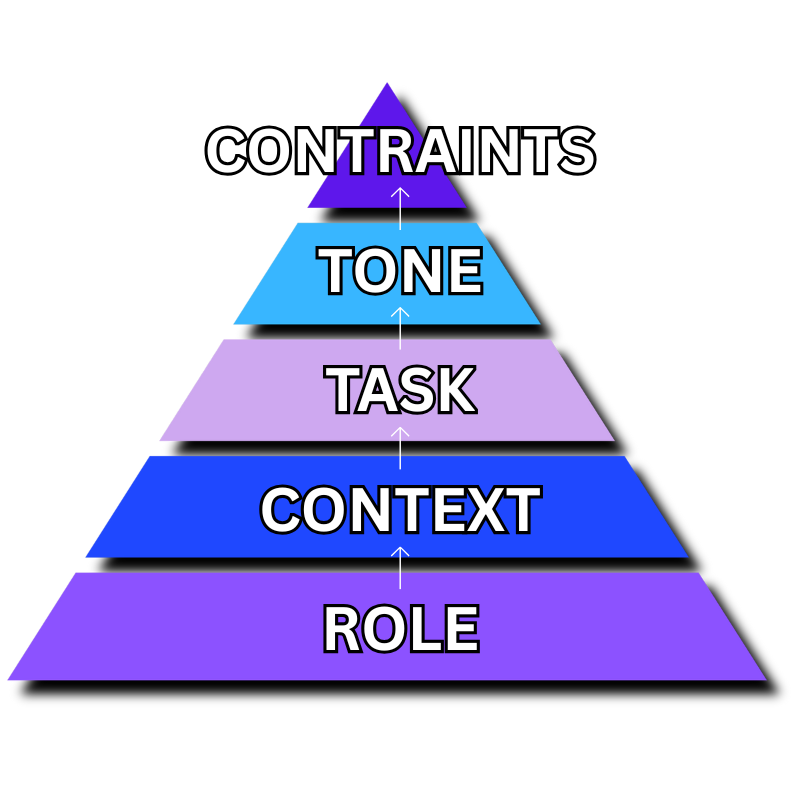
The Prompt Pyramid
The bottom defines what and who. The top layers refine how and where. When all five work together, you get clarity, consistency, and depth.
The Mindset Shift
Most people chase better outputs. Experts chase better thinking. Once you understand the anatomy of a great prompt, you stop guessing what to ask and start designing your requests intentionally.
This is where prompting becomes a skill — one you can apply to any model, any version, any task.
Next: Turn Structure Into Systems
You now understand what makes a prompt effective. Next, learn how to build prompts that scale, multi-step frameworks that let you reuse logic for writing, research, marketing, and more.
👉 Read next: [The 5-Layer Prompt Framework: The Blueprint for Consistent AI Results →]